
Social Work Programs offered at University of North Florida
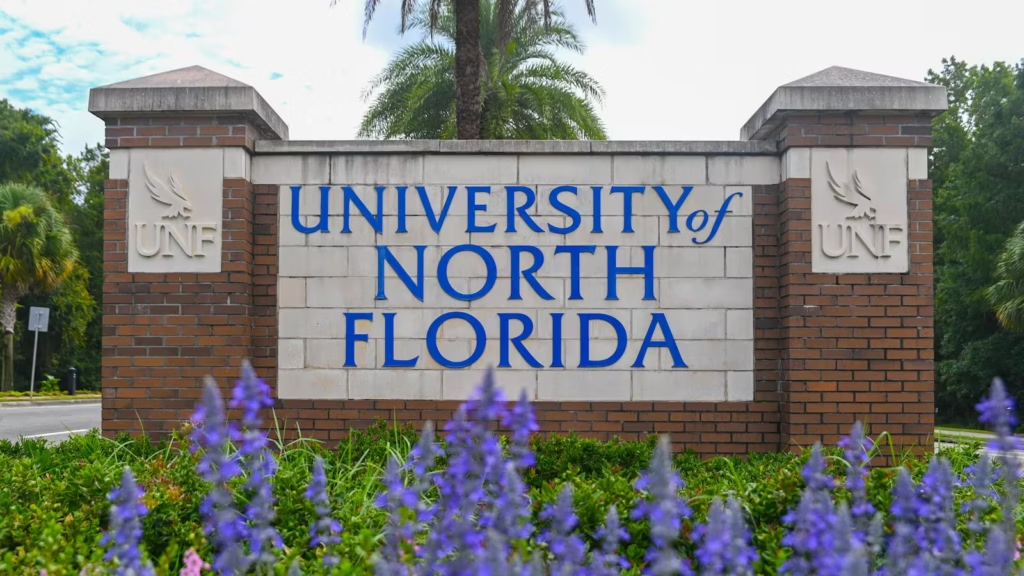
UNF’s social work education programs will give you the skills needed to make a meaningful difference in the lives of individuals, families, and communities. This school combines theory with hands-on skills to help students who are passionate about social justice and community well-being.
The Department of Sociology, Anthropology, and Social Work at UNF houses these programs. Students learn to analyze human behavior in social and cultural contexts, both locally and globally. The department’s steadfast dedication to education, research, and practical skills helps students serve communities of all types.
UNF’s Bachelor of Social Work (BSW) program gives you the knowledge and skills to provide effective social services in a variety of settings. Students become competent, ethical practitioners who boost well-being and help people facing life challenges. The BSW program admits students only in fall semester and offers both full-time and part-time options.
Students need 54 credit hours to complete the BSW program, which has courses in social work theory and practice. Electives let you learn more about specific client groups and practice settings. BSW students don’t need a minor, unlike other undergraduate programs in the department.
The BSW program’s field education component stands out. Following the Council on Social Work Education (CSWE) standards, students must complete 450 hours of field education. Second-year students participate in a two-semester supervised internship at approved sites. These internships are a great way to get hands-on experience in professional settings.
The Master of Social Work (MSW) program helps create compassionate, skilled, and ethical social work professionals. Students learn to lead with empathy and expertise while using evidence-based practices to promote social justice and strengthen communities.
The MSW program is accredited by the Council on Social Work Education and meets requirements for Licensed Clinical Social Worker (LCSW) licensure in Florida. This accreditation ensures high-quality education and professional opportunities for graduates.
Working professionals can easily access the MSW program through full-time and part-time options with afternoon and evening classes. The program uses a cohort-based, in-person format that makes shared learning and peer connections possible.
The Traditional MSW track takes two years and requires 60 credit hours. Students with a bachelor’s degree in any field can join. This track includes two internships: a 400-hour generalist internship and a 500-hour advanced generalist internship, giving students extensive professional experience.
The program’s mission promotes biopsychosocial-economic and spiritual well-being. Critical thinking, research, empowerment, and service form the foundation of this educational experience. Strategic collaborations enrich the curriculum. Small classes and dedicated faculty advisors provide tailored professional mentorship in a curriculum that combines experiential learning with research-based practice.
MSW students develop multi-method clinical and administrative skills through structured field education. These experiences help students practice the nine social work competencies required by CSWE’s Educational Policy & Accreditation Standards. Graduates can work effectively at micro, mezzo, and macro levels in community settings.
UNF works to create social change through comprehensive social work practice. The focus remains on achieving overall well-being, particularly for systematically marginalized and oppressed people. Both undergraduate and graduate programs reflect this commitment.
Students can participate in community-based internships, service learning, and research projects beyond regular coursework. These opportunities help apply classroom knowledge in real-life settings while contributing to communities.
Faculty members combine academic expertise with practical experience. Their mentorship bridges theoretical concepts with real-life applications. The department partners with nearly 100 local non-profit organizations and agencies that welcome student interns, creating reliable networks for field placements and professional connections.
UNF provides a supportive yet challenging environment whether you start with the BSW or advance through the MSW program. The focus on social justice, evidence-based practice, and hands-on learning prepares you for ethical and effective practice. Students develop strong foundations to address complex social challenges and promote human well-being in various contexts.
Where is University of North Florida located
The University of North Florida sits in Jacksonville, Florida. Students pursuing social work education will find an ideal learning environment here. You can find the university at 1 UNF Drive, Jacksonville, FL 32224. Most GPS services like Google Maps or Apple Maps will get you there.
The campus spreads across 1,300 acres within a natural preserve on Jacksonville’s Southside. Social work students thrive in this peaceful setting. They can focus on developing professional skills away from city noise while staying close to field placement sites.
The university’s location near I-295 (East Beltway) and SR-202 (J. Turner Butler Boulevard) makes it easy to reach from anywhere in Jacksonville. Social work students appreciate this accessibility when they travel between campus and their field placements throughout the area.
UNF’s sweet spot between downtown Jacksonville and the beaches gives students the best of both worlds. Social work students can experience urban and coastal environments. This mix helps them understand different community needs and populations.
Jacksonville ranks as one of America’s fastest-growing cities. Social work students here watch community development unfold right before their eyes. They see social service delivery and policy implementation in action. The city’s growth creates both challenges and solutions that teach valuable lessons.
New visitors should start at the UNF Welcome Center in Building 10, Suite 1500. The center welcomes guests Monday through Friday, 8 a.m. to 5 p.m.. Staff members share information about social work programs, lead campus tours, and connect you with program representatives.
UNF’s story began in 1969 with 1,000 acres set aside for development. Classes started in 1972 with 2,027 students. Today, nearly 17,000 students call UNF home. Both the campus and its academic programs have grown significantly.
The Department of Sociology, Anthropology, and Social Work houses the social work programs. This setup encourages shared learning across disciplines. Students develop a complete view of social issues through this approach.
The surrounding natural preserve adds unique value to social work education. Students interested in environmental justice, community development, or nature-based interventions find plenty of research opportunities here. This blend of nature and city life reflects the complex environments social workers face daily.
Jacksonville’s multicultural makeup helps students develop cultural awareness. They learn from different communities and understand various views on social issues. This exposure proves invaluable in their future careers.
MSW students at UNF benefit from the city’s professional network. They connect with agencies across Florida, find field placements, meet mentors, and discover job opportunities after graduation.
Jacksonville serves as a major healthcare hub with several medical centers and healthcare systems. BSW and MSW students interested in medical social work, mental health services, or substance abuse treatment find rich learning experiences here.
UNF’s campus design builds community spirit. Modern facilities support learning and research. Social work students use well-equipped classrooms and collaborative spaces to grow academically and professionally.
UNF combines a beautiful campus with access to diverse communities and professional opportunities. Social work students find everything they need here – strong academic resources, hands-on experience, and great quality of life.
UNF’s social work curriculum has detailed programs that give students professional skills at both undergraduate and graduate levels. Students from different educational backgrounds who want to pursue careers in social work will find suitable options here.
The Bachelor of Social Work (BSW) program builds a strong foundation for generalist social work practice. This limited access program admits a cohort of 40 students annually for the fall semester. Students can complete their studies in two years full-time or three years part-time. Before admission, students must complete 15 hours of state-mandated common prerequisites with a C or better.
The BSW application process follows several steps. Students need to submit applications by February 15th for the following academic year. They must have a minimum 2.5 GPA and 60 hours of college/university credit (junior standing). The BSW Admissions Committee then reviews applications based on prerequisite completion and academic performance. Students must attend mandatory interviews and complete writing assessments on campus. The process ends with admission notifications and a required orientation.
The BSW curriculum helps students develop nine key practice competencies required by the Council on Social Work Education (CSWE). The required coursework has:
- Social Welfare Institutions
- Human Behavior and the Social Environment
- Social Work Communication
- Research Methods
- Practice with Individuals, Families, Groups, and Communities
- Field Education components
Students must complete 450 hours of field education to meet CSWE accreditation standards. BSW students spend 400 hours in field education during their second year at approved social services organizations. This hands-on experience is a great way to get practical training in professional settings.
The BSW program prepares students with generalist knowledge, values, and skills to help clients in a variety of practice settings. Students learn about economic and social inequalities while developing a steadfast dedication to helping vulnerable, marginalized, and oppressed populations.
Students looking for advanced education can choose UNF’s Master of Social Work (MSW) program with multiple pathways. The MSW program prepares students for advanced generalist social work practice through critical thinking, research, and service. Students who complete this program can pursue licensure as a Licensed Clinical Social Worker (LCSW) in Florida.
The MSW program offers two tracks. The Traditional MSW track takes two years to complete 60 credit hours and welcomes students with bachelor’s degrees in any field. The Advanced Standing track works best for BSW graduates who can handle accelerated graduate study. Students in the Advanced Standing Program start during summer semester and can finish in one academic year.
Field education is central to social work education at UNF. Traditional MSW students complete 900 hours of field education – 400 hours at generalist practice level and 500 hours at advanced generalist level. Advanced Standing students need 500 hours at the advanced generalist level. These structured experiences help students develop skills for clinical and administrative practice with different populations and communities.
Working professionals can easily manage the MSW program schedule. Face-to-face classes happen on campus during late afternoon and evening hours. Students can balance their coursework with internships. The cohort-based structure creates collaborative learning environments and helps build meaningful connections with faculty and peers.
MSW program admission requires an online Graduate School application, $30 application fee, official transcripts, resume, three recommendation letters, and a personal essay. Both BSW and MSW programs at UNF have CSWE accreditation, which ensures graduates meet professional standards.
UNF social work students have many opportunities beyond their regular coursework. BSW students can join the UNF Social Work Club, attend the annual National Association of Social Workers Florida Legislation Education Day, work with the UNF Social Work Student Advisory Council, participate in Social Work Month events, study abroad, present research at the annual Student Research Symposium, and prepare for graduate school.
UNF’s social work programs excel at developing competent, ethical practitioners. Students receive personal professional mentorship from dedicated faculty advisors in small classes. The curriculum combines hands-on learning with research-informed practice. Graduates leave ready to tackle complex social challenges and help people in different contexts.
Field education at UNF
Field education is the substance of social work training at the University of North Florida. Students get hands-on learning experiences that connect classroom theory with professional practice. The “signature pedagogy” of social work education lets students apply their knowledge in real-life settings under professional supervision.
Bachelor of Social Work students face substantial field education requirements with a well-laid-out structure. They must complete 400 hours of field education in their second program year. Students work in approved social services organizations around Jacksonville. The program requires 450 total field hours, which lines up with Council on Social Work Education (CSWE) accreditation standards.
Students complete their field placements during the final program year as the culminating experience of undergraduate social work education. These placements are a great way to get exposure to potential future workplaces while developing professional skills for entry-level practice.
Master of Social Work program requirements differ based on your entry path. Traditional MSW track students must complete 900 hours of field education. Students split their time between two internships: 400 hours of generalist work and 500 hours of advanced generalist training. Students start with basic practice experiences and progress to complex interventions and responsibilities.
BSW degree holders who enter through the Advanced Standing MSW program complete one 500-hour advanced generalist internship. This optimized approach recognizes their undergraduate field experience and focuses on advanced practice skills.
UNF’s field education serves several purposes. Students learn to blend theoretical knowledge with practical application. The experiences help develop professional identity, create networks with community practitioners, and explore career paths in various social work settings.
Strong community partnerships drive the program’s soaring wins. The Department of Sociology, Anthropology, and Social Work collaborates with nearly 100 local non-profit organizations that welcome student interns. Students can work in organizations of all sizes, from child welfare and mental health to healthcare, substance abuse treatment, crisis intervention, and community development.
BSW students must meet specific requirements to start field education courses. Prerequisites need a grade of “C” or better, with a 2.5 or higher GPA in major courses. These standards ensure students have basic knowledge before working with clients.
Agencies have their own criteria for placement. Most sites need background checks at local, state, and federal levels, plus drug testing. These requirements match professional standards and legal obligations. Students with criminal history or substance use issues might struggle to complete the program since field education remains mandatory for graduation.
BSW students can find complete information about expectations and processes in the BSW Field Manual. MSW students have their own MSW Field Manual for graduate program policies.
Dedicated faculty members coordinate student placements and support successful field experiences. BSW students can reach out to Professor Nikki Runion, MSW, LCSW, the Field Education Director. MSW students work with Professor Rachel Mullins, MSW Field Education Director, for graduate-level placements.
Social service agencies can fill out the Field Education Host Agency Application to host UNF social work interns. This helps expand placement opportunities and strengthens university-community bonds.
Students participate in activities that reflect nine social work competencies required by CSWE’s Educational Policy & Accreditation Standards. These include ethical practice, diversity awareness, advocacy skills, research application, and intervention techniques at multiple system levels.
UNF’s field education shows the program’s dedication to community-based learning and service. These experiences prepare students for generalist and advanced generalist social work practice. Students develop practical skills in professional settings while helping local communities.
What sets University of North Florida apart?
UNF’s social work program stands out with its complete curriculum, prime location, and several unique features that improve the educational experience. Students benefit from a dynamic learning environment where academic excellence meets personal attention.
Both BSW and MSW programs use a cohort model that builds a shared learning community. Small class sizes let faculty advisors provide one-on-one professional mentoring. Students develop their professional identity and build lasting peer connections that often turn into valuable professional networks after graduation.
Working professionals will find UNF’s approach particularly appealing. MSW students can choose between full-time and part-time options with flexible afternoon and evening classes. This smart scheduling helps students balance their studies with work or field placements, making advanced degrees possible even with career commitments.
UNF’s social work program goes beyond technical training. It includes a deep commitment to social justice, equity, and evidence-based practice. This all-encompassing approach prepares students for technical excellence and ethical leadership when tackling complex social issues. Students gain a deeper understanding of economic and social inequalities, which promotes their commitment to helping vulnerable, marginalized, or oppressed populations.
Students can join a vibrant learning community through various activities:
- Join the active, student-led UNF Social Work Club
- Attend the annual National Association of Social Workers Florida Legislation Education Day in Tallahassee
- Participate with the UNF Social Work Student Advisory Council
- Present research at the annual Sociology, Anthropology, and Social Work Student Research Symposium
- Celebrate Social Work Month through events connecting students, faculty, alumni, and community partners
UNF offers unique international learning opportunities. Social work students have recently studied abroad in Indonesia, Iceland, and the United Kingdom[141]. These global experiences help build cross-cultural skills that today’s diverse practice settings value highly.
Each year, the BSW program admits just 40 students, which gives them a quality education with individual attention. This selective process maintains high standards and creates a close-knit learning community where faculty can really invest in each student’s growth.
Students should know that UNF’s social work programs have full accreditation from the Council on Social Work Education (CSWE). MSW graduates meet all educational requirements to become Licensed Clinical Social Workers (LCSW) in Florida, a crucial credential for many advanced positions.
Mutually beneficial alliances with community partners enrich classroom learning and field experiences. Faculty members actively work to improve social work delivery to poor and marginalized populations. This work connects theory with real-life applications in a dynamic environment that adapts to community needs.
BSW students looking to advance quickly can reduce their MSW degree time by one year. High-performing BSW students might qualify for the one-year Advanced Standing Master of Social Work Program, offering a faster path to graduate education.
Field education shows UNF’s dedication to community-based learning and service. BSW students complete 450 hours of field experience, while traditional MSW students do up to 900 hours. This is a big deal as it means that UNF graduates are ready for professional practice.
The BSW Admissions Committee looks at more than grades. They interview candidates and assess their writing to gage readiness for the profession. This careful evaluation helps find students who will excel both in class and in real-world settings.
UNF’s social work program combines academic excellence, community involvement, and ethical focus. Graduates become compassionate, skilled, and ethical professionals who make meaningful contributions across diverse settings.
Next steps
Want to get your social work degree at UNF? Here’s what you need to know about the application process and its competitive programs.
The Bachelor of Social Work (BSW) program accepts applications every year until February 15th for the next academic year. You need to meet some simple requirements – a minimum 2.5 GPA and 60 hours of college/university credit (junior standing). You should complete all prerequisites before the fall semester starts.
The BSW admission follows this timeline:
- Application submission (Deadline: February 15th)
- First review by the BSW Admissions Committee (Notifications by March 15th)
- Mandatory interview and writing assessment (Conducted March 27th)
- Final admission decisions (Notifications by April 10th)
- Enrollment confirmation (Due by April 24th)
- Required orientation (Typically held the week prior to fall semester)
Current UNF students should talk to an academic advisor to declare Social Work as their major and connect with the BSW Admissions Committee. Transfer students need to list Social Work as their intended major on their UNF application and submit all transcripts by the deadline.
The Master of Social Work (MSW) program has different application timelines based on your track. The Traditional MSW track gives you three options:
- Early Decision: Apply by February 1st with interviews conducted February 1-15 and decisions announced in late February
- Regular Review: Apply by March 31st with rolling interviews and decisions within two weeks
- Final Review: Materials accepted until April 15th with decisions announced by late April
The Advanced Standing MSW track has two options:
- Early Decision: Apply by February 1st with interviews February 1-15 and decisions in late February
- Final Review: Materials accepted until March 15th with decisions by late March
Your application package needs specific materials. MSW applicants must submit an online application through the Graduate School, pay a $30 application fee, and provide official transcripts, a resume, three recommendation letters, and a personal essay. Your essay should be 3-5 pages in APA style and should discuss your preparation for social work study, how you align with professional values, and what social problems interest you.
After interviews, you’ll receive an admission decision, rejection, or waitlist placement. Admitted students must confirm their enrollment by the deadline and attend mandatory orientation. Students on the waitlist might get admission if spots open up.
International students must meet an extra requirement – full admission to a full-time, on-campus, in-person, degree-seeking program at UNF. They also need their non-U.S. transcripts evaluated officially to match U.S. degree standards.
Missing deadlines can delay your education substantially. Start your application early to gather materials and prepare for interviews and writing assessments properly.